
Semrush Newsroom logo
  • Features
  • Pricing
  • Resourcesarrow icon

    • Blog

      Read the industry's latest thoughts on digital marketing, content strategy, SEO, PPC, social media and more.

    • Help Center

      Learn how to use Semrush with user manuals, how-to’s, videos and more!

    • What's New

      Keep track of the newest Semrush features and improvements.

    • Webinars

      Register and take part in educational webinars conducted by the best digital marketing experts.

    • Ebooks

      A range of downloadable guides in PDF format that can help you broaden your knowledge and improve your skills.

    • Hire a Trusted Agency

      Pressed for time? Need rare skills? Get help from a trusted agency. Our experts work with marketing projects of all kinds and budgets.

    • Academy

      Get vital SEO skills, learn how to use our toolkits and get official certificates of your proficiency in SEO and Semrush.

    • Top Websites

      Discover the most visited websites. Analyze their traffic and search rankings. Choose country or industry to find out who currently leads the market.

  • Companyarrow icon

    • About Us
    • Newsroom
    • Careers
    • Success Stories
    • Data Studies
    • Affiliate Program
    • For Investors
    • Partner Integrations
    • Contacts
    • Stats and Facts
  • Marketplace
Menumenu icon
user icon
menu icon
  • News
  • Data & Insights
  • Company News
  • Product News
  • Press Kit
Search icon
  • Features
  • Pricing
  • Resourcesarrow icon

    • Blog
    • Help Center
    • What's New
    • Webinars
    • Ebooks
    • Hire a Trusted Agency
    • Academy
    • Top Websites
  • Companyarrow icon

    • About Us
    • Newsroom
    • Careers
    • Success Stories
    • Data Studies
    • Affiliate Program
    • For Investors
    • Partner Integrations
    • Contacts
    • Stats and Facts
  • Marketplace
Semrush Newsroom logo
  • News
  • Data & Insights
  • Company News
  • Product News
  • Press Kit
✕
Main page /Data & Insights

Holiday Shopping 2025: What Traffic Data Reveals About Search, AI, and How People Actually Buy

January 21, 2026
Holiday Shopping 2025: What Traffic Data Reveals About Search, AI, and How People Actually Buy
The 2025 holiday shopping season followed a familiar rhythm: early research, a compressed deal frenzy, a deadline-driven December, and then a quiet post-holiday reset. But beneath that familiar shape, Semrush traffic data from 19 of the world’s largest retailers reveals something new about how shoppers made decisions and where AI quietly entered the process.
This analysis looks at daily traffic across 19 major retailers from November 1, 2025, through January 9, 2026, capturing 70 days of holiday shopping behavior across three channels:
  • Total traffic (all sources)
  • Organic search traffic
  • AI referral traffic
Across the full window, those retailers generated: 5.87B total visits, 1.055B visits from organic search, 8.87M visits from AI referrals. In practical terms, that means:
  • Organic search accounted for roughly 18% of all retail traffic – large, stable, and commercially essential.
  • AI referrals made up about 0.15% of total traffic – still small in scale, but increasingly revealing in how and when people shop.

Three things the data makes clear

1. Cyber Monday was the undisputed center of gravity for holiday shopping.

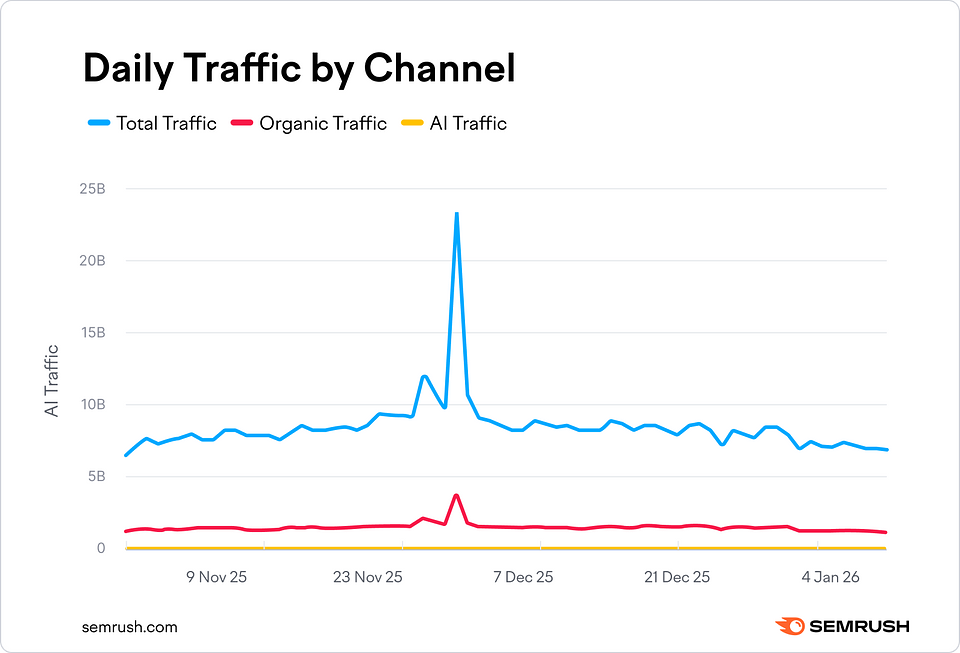
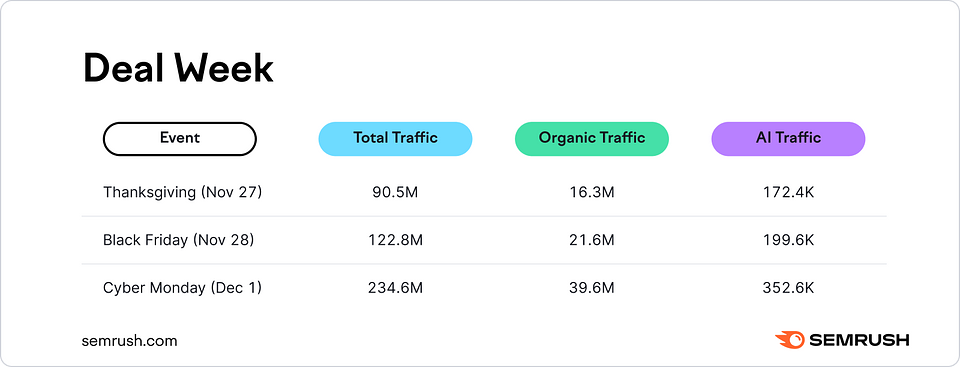
On December 1, 2025, total traffic across the retailers analyzed hit 234.6 million visits, the highest point in the entire dataset, with Cyber Monday replacing Black Friday as the biggest online retail day. Organic search traffic peaked the same day at 39.6 million visits, while AI referrals also reached their seasonal high at 352,600 visits.
Compared with the early-November baseline, Cyber Monday drove:
  • +200% growth in total traffic
  • +179% growth in organic search
  • +213% growth in AI referrals
When shoppers were ready to buy, every channel surged at once.
Source: Semrush Traffic Analytics

Source: Semrush Traffic Analytics

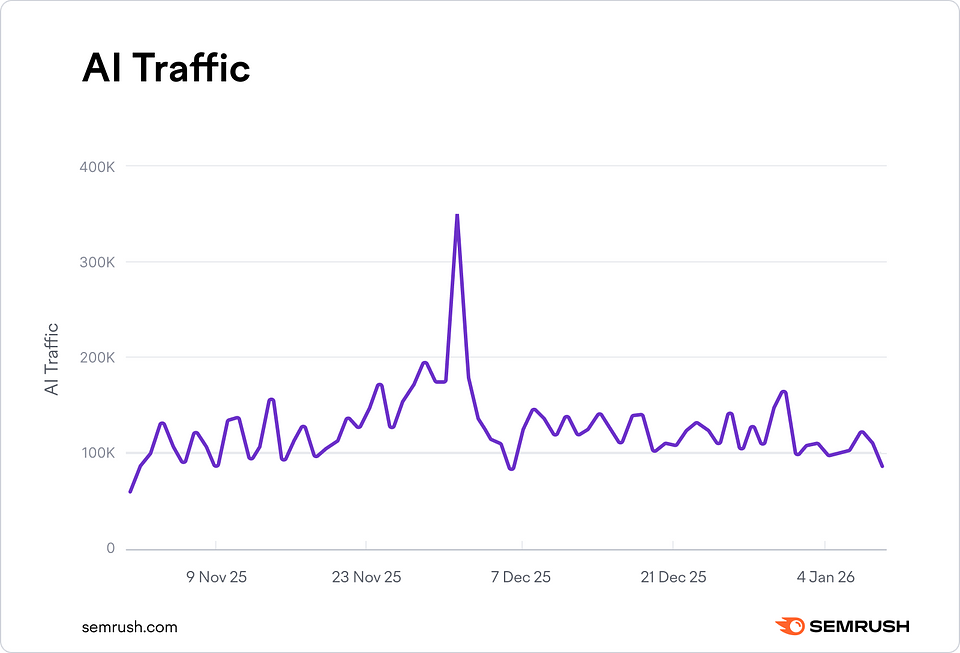
2. AI traffic follows deal moments – but its relative importance spikes on quieter, less obvious days.

AI’s largest volumes align with the retail calendar: Black Friday weekend through Cyber Monday. But AI’s highest share of total traffic (total visits over time) appears on days like November 14 and December 31 – moments that are not defined by promotions, but by indecision. Those spikes suggest AI is being used disproportionately for “help me decide” moments: gift ideation, comparisons, “best X under $Y,” substitutions, and post-holiday reassessment, but not just mass checkout.
Source: Semrush Traffic Analytics

Source: Semrush Traffic Analytics

3. Organic search remains dominant — because it still connects intent to action.

Even as AI usage grows, organic search remains the most scalable and repeatable driver of high-intent retail discovery. This holds true especially in relation to inquiries around deals, shipping cutoffs, store hours, returns, and product availability. Its predictability during peak weeks is exactly why retailers continue to build their holiday playbooks around it.

The shape of the season: what shoppers actually did

Phase 1: Early November — browsing, planning, warming up

From November 1 to November 23, shopping demand was steady but restrained. Across the 19 retailers, the daily average was 78.1 million total visits, 14.2 million organic-search visits, and 112,600 AI referrals.
This was the classic browse-and-plan period. Promotions were starting to ramp up, wishlists were forming, and shoppers were researching categories rather than specific products. AI was present during this phase, but not accelerating — a signal that it was being used primarily for exploration and comparison, not purchase.

Phase 2: Deal week — when the internet becomes a checkout line

From November 24 through December 3, the entire season was compressed into a handful of days. Key moments stand out clearly in the data:
Chart 3 - Deal Week-Events-1.png
One nuance matters here. On Cyber Monday, organic search’s share of total traffic dipped slightly to around 16.9%, compared with closer to 19% later in December. That doesn’t indicate organic weakening. It reflects everything else exploding: direct traffic, retail apps, email campaigns, paid media, affiliates, and push notifications all peaking simultaneously. When retailers go full throttle, the channel mix shifts — even as search traffic continues to grow in absolute terms.

Phase 3: Mid-December — when gift giving constraints set in

From December 4 through December 19, total traffic stabilized, yet fell below Cyber Week highs. This is where shopping behavior changed most noticeably: instead of chasing deals, shoppers focused on the increasing pressure with gift giving: Will it arrive on time? Is it in stock? Can it be returned? Is there a store nearby?
Organic search captured these transactional queries — “shipping cutoff,” “store hours,” “promo code,” “return policy,” “in stock,” “near me” — and remained strong and steady throughout the period. Meanwhile, AI traffic began to behave less like deal hunting and more like decision support. Spikes are increasingly aligned with moments of comparison and reassurance rather than discounts.

Phase 4: Hanukkah and Christmas — multiple peaks, different rhytms

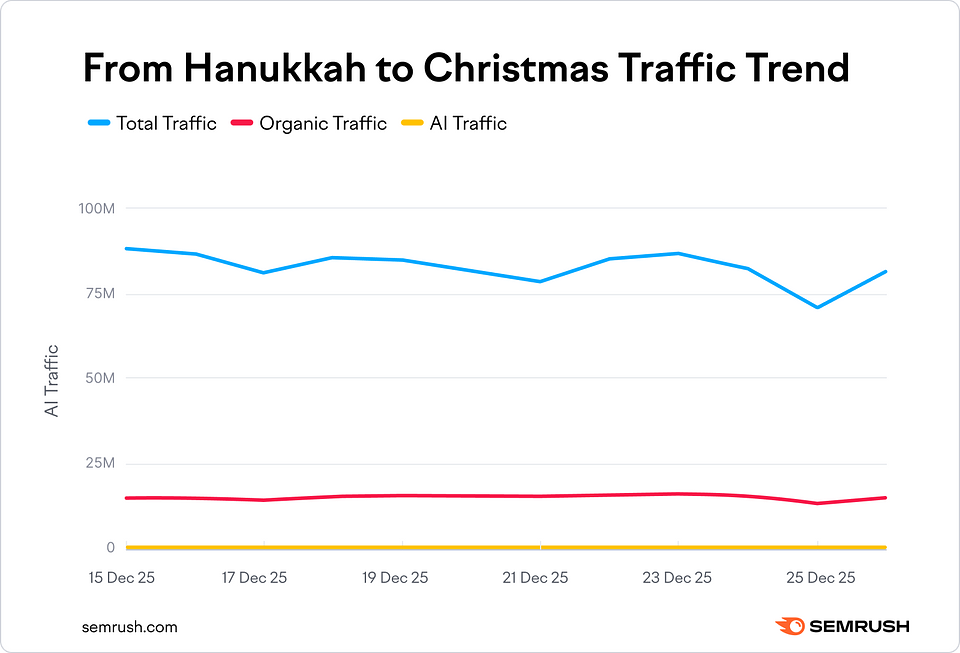
Hanukkah ran from December 14 to December 22, and overlapped with the final Christmas rush, spreading demand across several smaller peaks rather than one dominant spike. Hanukkah sustained demand across multiple days, while Christmas concentrated activity around a shorter window, resulting in several smaller peaks rather than a single dominant spike. 
Chart 4 - From Hanukkah to Christmas-Traffic Trend.png
Organic search’s share of total traffic rises in late December, reinforcing its role as a dependable utility channel once promotional pressure eases.

Phase 5: Post-Christmas to early January — returns, gift cards, resets

After Christmas, overall traffic declined, as it does every year, but shopper behavior shifted again. On New Year’s Eve (December 31), retailers still recorded 78.5 million total visits, including 15.1 million from organic search and 169,600 AI referrals.
AI accounted for roughly 0.216% of total traffic that day — one of the highest shares in the entire dataset. This late spike points to a familiar post-holiday mindset: exchanges, gift-card spending, “what I actually wanted,” and early planning for home, fitness, and organization projects.

Where AI traffic concentrates — and why it makes sense

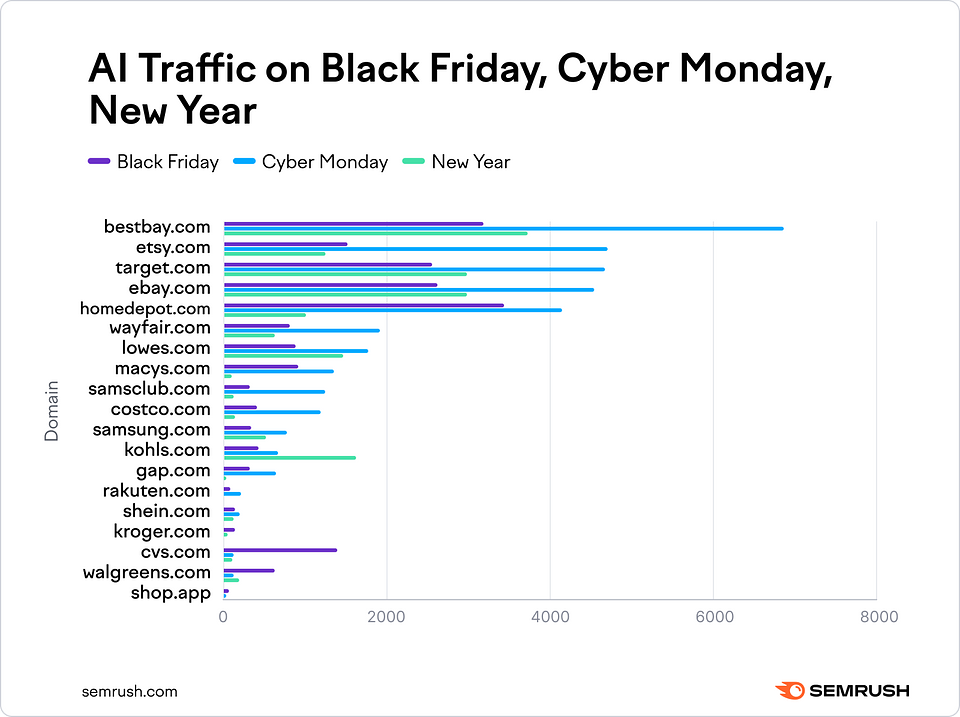
Across the full period, the largest volumes of AI referrals went to eBay (~1.52 million), Etsy (~1.23 million), Target (~1.20 million), Best Buy (~1.13 million), and Home Depot (~1.06 million).
Chart 5 - AI Traffic-BF,CM,NY.png
The clearest pattern isn’t about scale, but category. Retailers in high-consideration segments — electronics, home improvement, furniture, and gifting — consistently show higher AI traffic share, reflecting how shoppers use AI for comparison and decision support. Best Buy (~0.30%), Home Depot (~0.24%), Etsy (~0.23%), Target (~0.22%), Wayfair (~0.20%), and Lowe’s (~0.19%) all over-index on AI relative to their overall traffic.

AI “spike days” reveal intent, not just volume

Looking at individual retailers reinforces the point:
  • Best Buy saw its biggest AI day on Cyber Monday, followed by Black Friday weekend — but also a notable bump on December 31, consistent with upgrade and gift-card shopping.
  • Home Depot showed strong Black Friday activity, peaked on Cyber Monday, and then spiked again on January 7, a classic signal of “new year, new projects.”
  • Etsy clustered AI traffic in early and mid-December, aligning with gift discovery and more open mind on what the perfect gift could be.
  • eBay’s top AI day was November 14, well before deal week — suggesting heavy use of AI for researching alternatives long before checkout.

Why organic search still matters more — even as AI grows

The numbers make the case clearly. Over this period organic search drove ~1.055 billion visits while AI referrals drove ~8.87 million. That’s roughly 119× more traffic from search than from AI. Search remains dominant because:
  • It captures explicit, commercial intent.
  • Retail infrastructure is built for it — category pages, gift guides, inventory-indexed listings, store pages, FAQs, returns policies.
  • It performs best during deadline-driven moments, when certainty matters more than inspiration.
AI, by contrast, is strongest earlier and later in the journey. It’s powerful — but today, it’s still a discovery and decision layer, not the main highway to checkout.

The takeaway for retailers heading into 2026

The 2025 holiday season didn’t mark a handoff from search to AI. It showed how the two now coexist.
Organic search remains the backbone of retail discovery — capturing urgency, intent, and last-mile decision-making at scale. AI, meanwhile, is beginning to influence the moments before and after the transaction, when shoppers are uncertain, comparing options, or deciding what comes next.
Winning in this environment isn’t about choosing one channel over the other. It’s about understanding where each one matters — and designing for both.

How Semrush helps brands win both sides of discovery

Semrush is built for this new reality.
With Semrush One, brands can manage AI SEO and SEO in a single platform, ensuring organic search remains strong, scalable, and resilient.
With Semrush AIO (AI Optimization), brands can measure and improve how they appear in AI-generated answers, citations, and assistant-driven discovery — the layer that increasingly influences decisions when consumers need guidance, not just links.
Together, they reflect a simple truth the shopping season data makes clear:
Winning today isn’t about choosing between organic and AI. It’s about owning both.

Download as

PDF
DOCX

Share

Relevant news

2026 Predictions: The First Year Marketers Must Win Both Worlds — SEO and AI Search

A Visibility Outlook from the Semrush Leadership Team
Data & Insights
December 19, 2025

3 Months of AI Visibility Index Data: Here's What We've Learned About AI Search

Showcasing Who’s Winning AI Search
Data & Insights
November 4, 2025

New Ecommerce Report from Semrush + Statista Explores Tariffs, AI, and Social Commerce Impacts in the U.S.

A new report from Semrush Traffic & Market and Statista unpacks the data showing how tariffs, artificial intelligence, and shifting consumer behaviors are reshaping the U.S. ecommerce market.
Data & Insights
October 15, 2025
twitter iconfacebook iconlinkedin iconinstagram iconyoutube iconpinterest icon

location iconUSA, 800 Boylston Street, Suite 2475, Boston, MA 02199

mail iconContact us
USA, 800 Boylston Street, Suite 2475, Boston, MA 02199

or see our plans & pricing

Semrush
  • Features
  • Pricing
  • Success Stories
  • Stats and Facts
  • Insights
  • News
  • Custom Report
Help
  • Knowledge Base
  • Academy
  • Semrush API

Community
  • Semrush Blog
  • Webinars
More Tools
  • Analytics Reports
  • Projects
  • Content Marketplace
  • Agency Partners
  • Affiliate Program
  • SEOquake
  • Sensor
  • Prowly
  • Kompyte
  • App Center
Company
  • About Us
  • Newsroom
  • Careers
  • Partners
  • Legal Info
  • Privacy Policy
  • Security Info
  • Do not sell my personal info
  • For Investors
  • Contact us
Follow Us
  • menu icon
    Twitter
  • menu icon
    Facebook
  • menu icon
    LinkedIn
  • menu icon
    Instagram
  • menu icon
    YouTube
  • menu icon
    Pinterest
Language
  • English
  • Español
  • Deutsch
  • Français
  • Italiano
  • Português (Brasil)
  • Русский
  • 中文
  • 日本語
© 2008 - 2023 Semrush. All rights reserved.